
This circuit can light a small fluorescent lamp (4 to 15 W) from batteries or battery. It can be used in emergency lighting systems or with alternative sources, such as those that make use of solar cells.
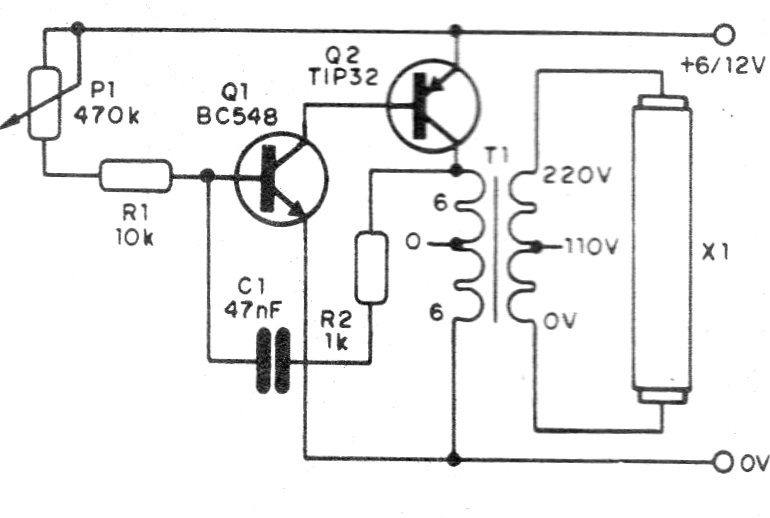
The circuit shown converts a low battery voltage or 6 to 12 V battery into a high voltage capable of lighting a small fluorescent lamp.
Even lamps that no longer work in the power grid can be used, since the high voltage peaks still can ionize the gas inside the lamp.
The brightness of the lamp is set to P1, but is usually below the lamp normal given the efficiency of the circuit.
In figure 1 we have the complete diagram of the apparatus.
The assembly based on a small terminal bridge is shown in figure 2.
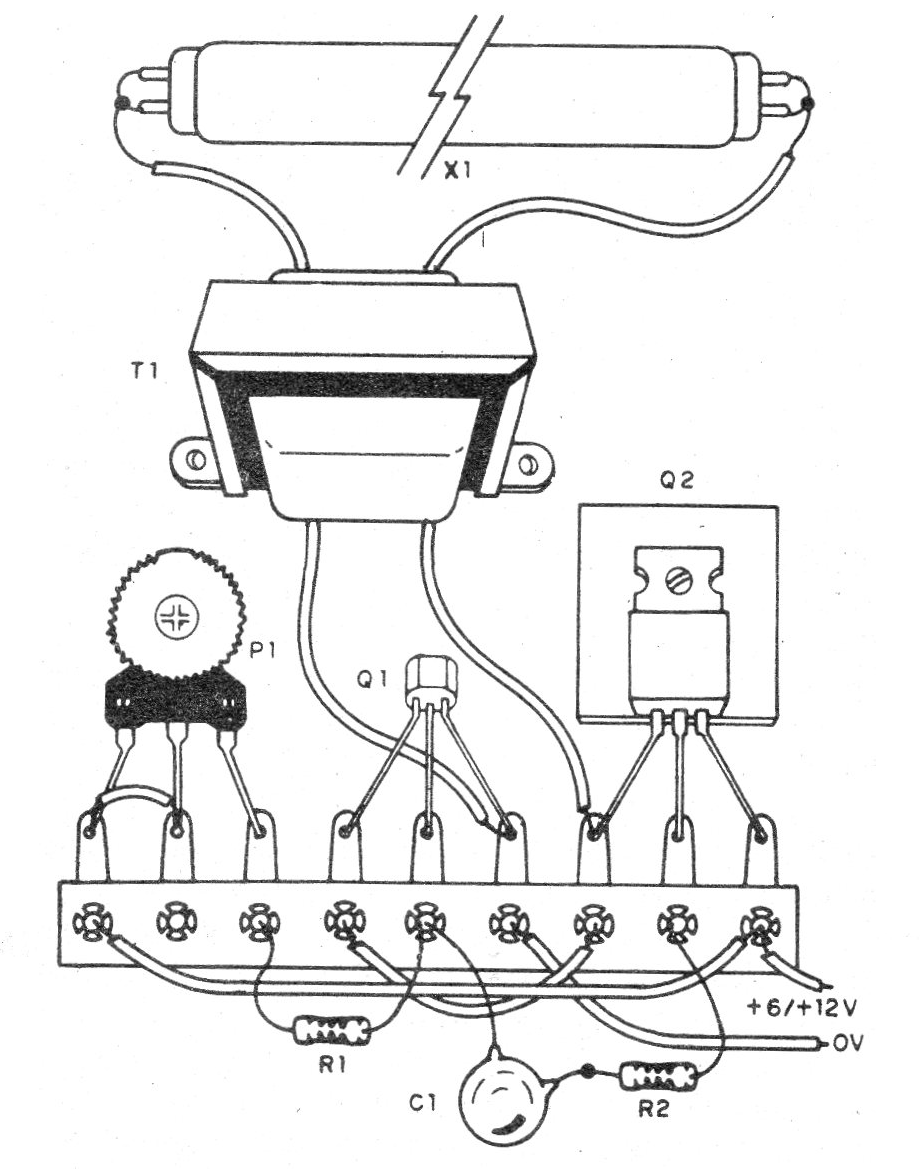
Transistor Q2 must be equipped with a small heat radiator.
The radiator consists of a small metal plate attached to the transistor by a screw.
The transformer may be any one having a secondary from 6 to 12 V with a current of 200 to 500 mA and a primary of 110 V or 220 V.
The device has a high consumption and is not recommended for use with small batteries.
Material list
Q1 - BC548 - NPN general purpose transistor
Q2 - TIP32 - PNP power transistor
T1 - Transformer - see text
P1 - 470 k ohms - potentiometer
R1 - 10 k ohms x 1/8 W - resistor - brown, black, orange
R2 - 1 k ohms x 1/8 W - resistor - brown, black, red
C1 - 47 nF - ceramic or polyester capacitor
X1 - 5 to 15 W Fluorescent Lamp
Several:
Terminal strip, mounting box, transistor heatsink, wires, solder, etc.


