
This setting always appears in designs or applications where there is too little signal source to directly drive the input of an amplifier. Thus, microphones, guitar capsules and experimental radios can be connected to an amplifier without problems, using the AUX (auxiliary) input.
The circuit uses only a general purpose PNP transistor such as BC558 or BC559, and is powered by four small batteries, or even a 9 V battery, because its consumption is low. The circuit has its gain determined by R2 which, eventually, must be changed to not generate distortion, depending on the signal source. The complete pre-circuit is shown in Figure 1.
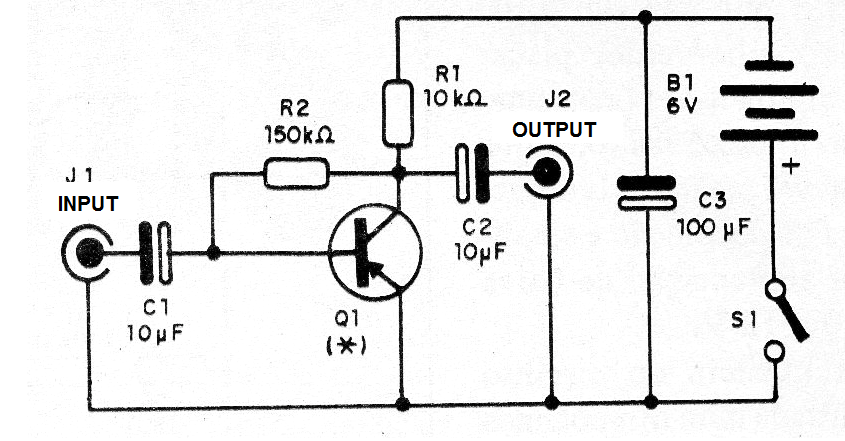
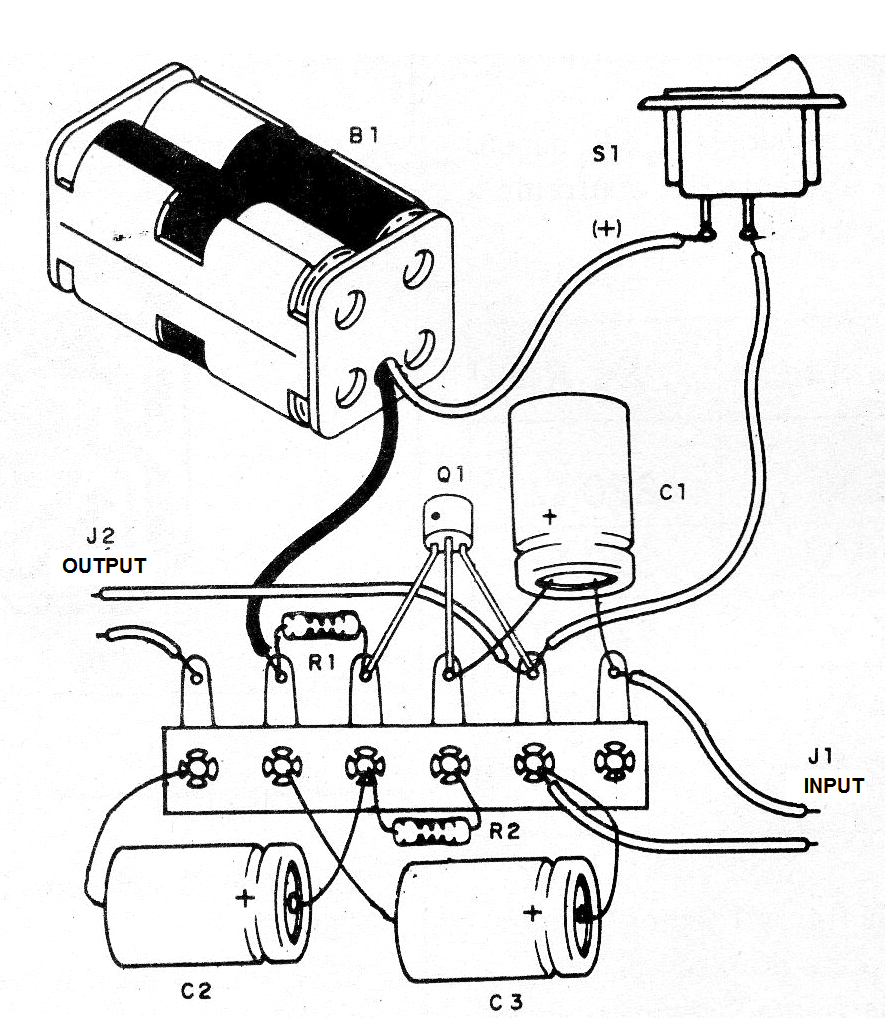
Assembly can be done using a terminal bridge. If the box is not metal, to provide shielding, the signal input and output cables must be shielded. In Figure 2, we show the mounting on a terminal bridge.
The circuit operates with 100 mV at 1 V amplitude for the input signals.
Material list
Q1- BC558 or any NPN of general use
S1 - Single switch
B1 - 6 or 9 V - 4 batteries or battery
J1, J2- Input jacks
C1, C2 - 10 uF x 12 V or more - electrolytic capacitors
C3 - 100 uF x 12 V or more - electrolytic capacitor
R1 - 10 k ohms x 1/8 W - resistor - brown, black, orange
R2 - 150k ohms x 1/8 W - resistor - brown, green, yellow
Miscellaneous: terminal strip, mounting box, battery holder or battery connector, wires, welding, etc.


