
Small speakers can be used as sensitive microphones in many practical applications. However, such microphones do not have a signal strong enough to excite a common amplifier requiring the use of a preamplifier. The same goes for many low-impedance microphones, such as those used in recorders.
The circuit we describe allows the use of a small speaker of 2.5 to 5 cm as a microphone or a low impedance magnetic microphone with common amplifiers that require at least 100 mV for excitation.
Powered by 4 batteries or battery, the consumption of this device is very low, which means a great durability for the power source.
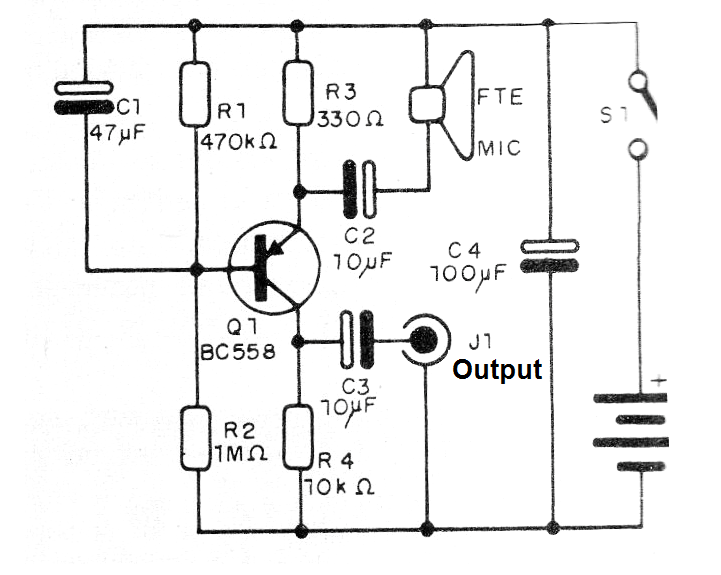
In figure 1 we have the complete diagram of this preamp for low impedance microphone.
In figure 2 we have the assembly made based on a terminal strip.
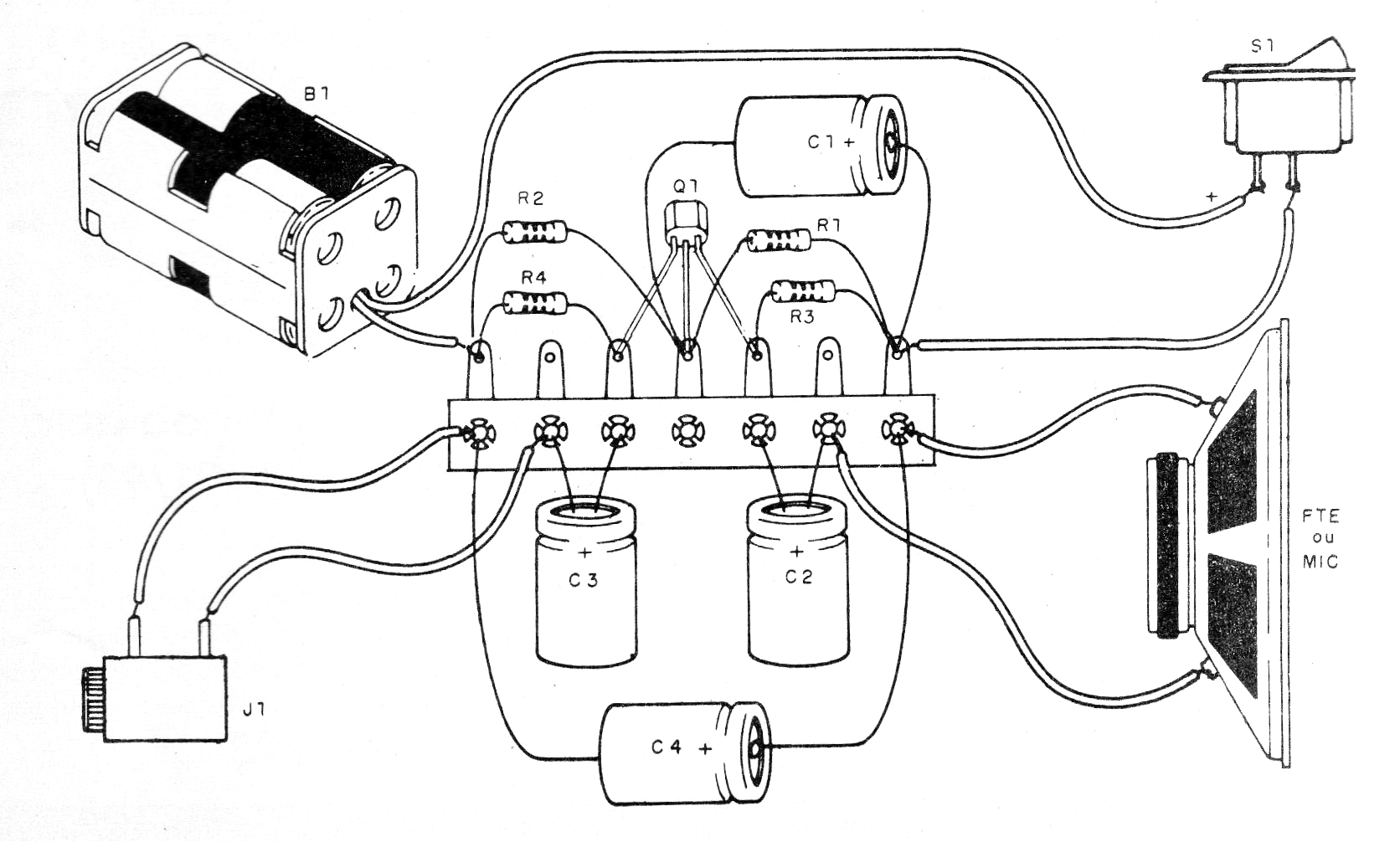
The transistor is a BC558 or any PNP equivalent. For the output a shielded cable with plug must be used according to the input of the amplifier.
The resistor R4 can be changed to modify the gain of the circuit. Its value can be between 4.7 k 22 k. Likewise, R3 can be between 100 ohm and 470 ohm, depending on the impedance of the speaker or microphone.
Material list:
Q1- BC558 - general purpose PNP transistor
S1- Single switch
B1-6 or 9 V - 4 batteries or battery
MIC- Low impedance microphone or loudspeaker
R1- 470 k ohm x 1/8 W - resistor - yellow, violet, yellow
R2 - 1 M ohm x 1/8 W- resistor - brown, black, green
R3 - 330 ohm x 1/8 W- resistor - orange, orange, brown
R4 - 10k ohm x 1/8 W- resistor - brown, black, orange
C1-47 uF- electrolytic capacitor
C2, C3 -10 uF- electrolytic capacitors
C4 - 100 uF - electrolytic capacitors
Miscellaneous:
Terminal jumper, Jacks and plugs, mounting box, battery connector or battery holder, wires, solder, etc.


