
Common batteries such as dry and alkaline batteries can not be recharged. The chemical process of supplying energy from these cells consists of irreversible reactions.
However, depending on the use, the batteries often show signs of exhaustion, either by the formation of gases or by the slower speed of action of the polarizers, without being able to fully power the power supply.
For these cells a small current of excitation or rejuvenation can help prolong their life with the supply of energy for some time.
Of course, this process must be done with care, because a very intense current, especially in the alkaline batteries, can cause its explosion or leakage.
So, what we propose is a rejuvenating circuit that serves for ordinary batteries, and in some cases, when the battery is not fully exhausted, prolong its capacity of operation for some more time.
The circuit consists of a simple low-current source in which the batteries must be connected. This circuit is shown in figure 1.

The resistors are selected according to the cells to be stimulated.
The circuit allows the simultaneous recharging of 1 to 4 AA, C and D type batteries and even 9 V batteries. The polarity of the connection of the batteries under rejuvenation must be observed.
The rejuvenation time varies between 1 and 6 hours depending on the condition of the batteries.
Of course, prolonged battery life is not guaranteed after many times it is placed in this apparatus, because as we said the reactions in its interior is irreversible. What we do is just extend the service life.
The transformer used must have primary winding according to the local and secondary network from 9 to 12 V with current between 500 mA and 800 mA.
In figure 2 we have the final appearance of the assembly.
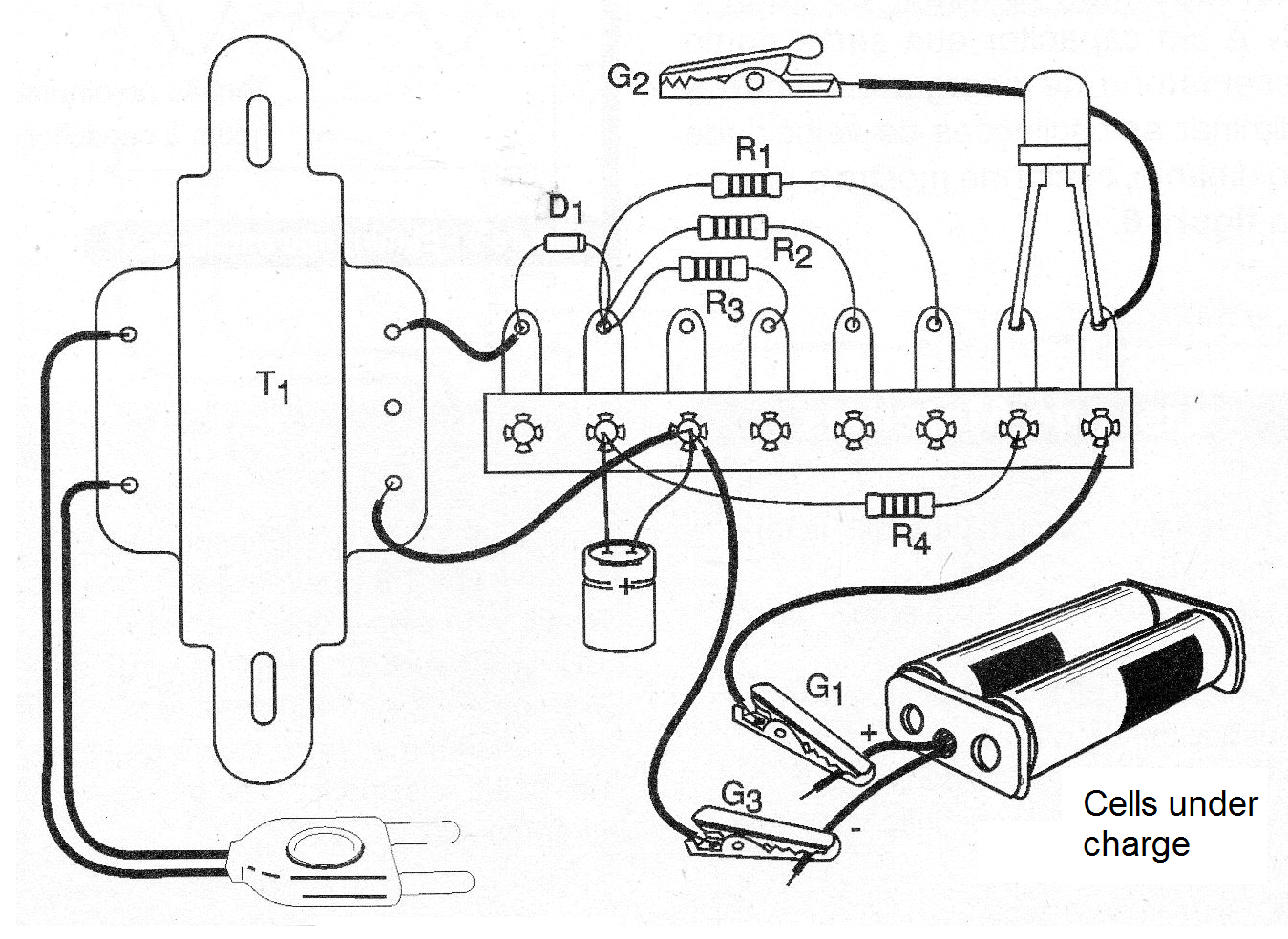
Use red and black clips to make your connection to the rejuvenating battery holders, always observing their polarity. If you notice any signs of leakage or heating in a battery, remove it from the holder and discard it since it will not allow any further prolongation of the life of the battery.
Remember that there are recommended procedures for disposing of batteries, as the substances inside them are toxic.
Parts list
D1 - 1N4002 - silicon rectifier diode
LED1 - Common red LED
T1 - Transformer - see text
R1 - 470 ohms x 1 W - resistor
R2 - 220 ohms x 2 W - resistor
R3 - 100 ohms x 2 W - resistor
R4 - 1 k ohms x 1/8 W - resistor
C1 - 470 uF x 30 V - electrolytic capacitor
G1, G2 - Red and black alligator clips
Miscellaneous:
Power cable, battery holders, mounting box, wires, solder, etc.


