
With this apparatus we can verify if a material is conductive or insulating in a simple and interesting demonstration of these properties of the materials.
What to explain:
If we touch the probes made with small nails in a conductive material, the current passes and the circuit is closed, lighting the lamp.
On the other hand, if the material touched is insulating the current can not circulate and the lamp does not light.
If the lamp lights up with less brightness, it is because the material tested is a bad conductor ie it has a certain electrical resistance.
Show that between conductors and insulators there are intermediate materials.
Experiment with metal objects, pins, paper clips, etc. and also insulators like paper, plastic.
Test with graphite from a pencil and with liquids such as water and salt.
A poster explaining what happens is important so that the demonstration on a fair stand is complete.
In figure 1 we have the assembly aspect.
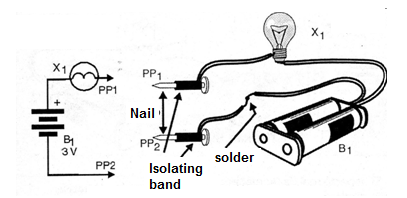
The probes are improvised with two large nails in which the strands will be fastened with insulation tape.
The wires can be soldered directly into the base of the lamp after scraping the spot so that welding "picks up" more easily.
Suitable batteries must be used for batteries.
The lamp is 3 V, but a 6 V lamp can be used if the stand is replaced by one of 4 batteries.
Material list
B1 - 3 V - 2 small, medium or large batteries
X1 - 3-Volt Lamp - Two-Battery Flashlight
PP1, PP2 - Probes made with two nails
Several:
Support of batteries, nails, insulation tape, wires, solder, etc.


